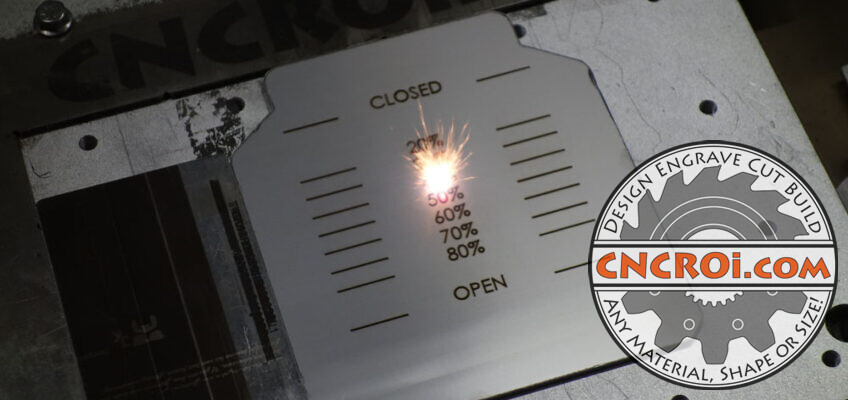
304 vs 316 Fiber Laser Metal Plaques
Procurement managers, engineers, and maintenance supervisors responsible for industrial identification systems, including specifying durable metal plaques, are under constant pressure to choose solutions that will hold up in real-world conditions, not just on paper
Across manufacturing plants, energy facilities, transportation fleets, and infrastructure projects throughout Canada and the United States, identification is tied directly to safety, traceability, and uptime. When labels fail, operations feel it through downtime, confusion, and compliance risk.
Fiber laser etched 304 and 316 metal plaques have become a trusted solution in these environments because they combine permanence with practical durability, helping teams avoid the recurring headaches associated with fading, peeling, or corroding labels. CNCROi.com specializes in producing these plaques for demanding industrial use, where consistency and long-term performance matter more than short-term savings.
Fiber laser etched 304 and 316 metal plaques are built on a straightforward principle. The base material must survive the environment, and the marking must last just as long. Stainless steel delivers the foundation. Type 304 stainless steel is widely used because it offers strong resistance to oxidation and general corrosion in indoor and moderately demanding environments. It performs reliably in most manufacturing settings, warehouses, and equipment rooms.
Type 316 stainless steel takes that a step further by adding molybdenum, which significantly improves resistance to chlorides and aggressive chemicals. This makes it a better choice for coastal operations, wastewater treatment facilities, food processing plants with frequent washdowns, and any environment where exposure to salt or harsh cleaning agents is expected. CNCROi.com routinely works with clients to determine whether 304 or 316 is appropriate based on actual operating conditions rather than assumptions, which helps avoid premature failures.
In practice, the difference between 304 and 316 becomes clear over time. Facilities that initially specify 304 in borderline environments often find themselves replacing plaques sooner than expected due to pitting or surface degradation.
In contrast, 316 stainless steel continues to perform, even after years of exposure to salt spray or chemical cleaning cycles. In ASTM B117 salt spray testing, 316 consistently shows improved resistance to corrosion over extended durations, often exceeding 1000 hours with minimal surface impact.
For procurement teams looking at long-term performance rather than short-term savings, this difference directly affects replacement cycles, labor costs, and the risk of losing critical identification. CNCROi.com frequently sees projects where clients upgrade from 304 to 316 after experiencing failures in the field, and that transition often eliminates recurring replacement issues.
The marking process is just as important as the material. Fiber laser etched 304 and 316 metal plaques use a non-contact process that alters the surface of the stainless steel at a microscopic level. This creates a high-contrast, permanent mark without relying on inks, coatings, or adhesives. There is nothing to peel, fade, or wear away. In field conditions, this matters.
Maintenance teams regularly encounter older labels where the material is still intact but the information is no longer readable. That is a failure point that fiber laser etching eliminates. CNCROi.com uses industrial-grade fiber laser systems to ensure consistent depth, contrast, and legibility across production runs, which is especially important for serialized or compliance-driven applications.
Real-world performance data supports this approach. Fiber laser etched 304 and 316 metal plaques remain legible after prolonged UV exposure, extreme temperature swings, and repeated cleaning with industrial solvents. In high-heat environments, these markings can withstand temperatures exceeding 500 degrees Celsius without loss of contrast. In outdoor installations across North America, where equipment is exposed to sun, rain, snow, and road salt, this level of durability translates into years of reliable identification without intervention. CNCROi.com has produced plaques used in outdoor and heavy industrial environments where failure is not acceptable, and the expectation is that the marking will outlast the equipment itself.
Mechanical durability is another area where fiber laser etched 304 and 316 metal plaques stand out. Industrial environments are not gentle. Equipment is handled, cleaned, and sometimes bumped or scraped during normal operation. Unlike printed labels or anodized aluminum tags, which can show wear relatively quickly, stainless steel plaques with laser etching maintain their integrity. Even after repeated pressure washing or solvent cleaning, the marking remains intact. Maintenance supervisors benefit directly from this because it reduces the need for ongoing label replacement and helps ensure that critical information is always available when needed. CNCROi.com often works with maintenance teams who are replacing failing label systems and want a permanent upgrade.
Attachment methods play a key role in overall performance and should not be overlooked. Fiber laser etched 304 and 316 metal plaques can be tack welded, fully welded, or riveted to equipment depending on the application. Tack welding is often used for quick, secure attachment where minimal heat input is preferred. Full welding provides the highest level of permanence and is ideal for heavy-duty applications where the plaque must become a permanent part of the equipment. Riveting remains a popular option for flexibility, especially when welding is not practical or when plaques may need to be replaced or updated in the future.
CNCROi.com can supply plaques designed specifically for these attachment methods, including hole placement, edge finishing, and thickness considerations to match the installation environment.
Failure analysis of industrial labeling systems often highlights a combination of issues rather than a single cause. In many cases, labels fail because the marking fades, the material corrodes, or the attachment method cannot withstand the environment.
Fiber laser etched 304 and 316 metal plaques address these risks as a complete system. The material resists corrosion, the marking remains legible, and the attachment can be tailored to the application. This integrated approach reduces the likelihood of failure and provides a more dependable solution over the lifecycle of the equipment. CNCROi.com regularly consults with clients during the RFQ stage to identify these risks early and recommend specifications that prevent costly mistakes.
Cost is always part of the conversation, and it is where many buyers initially hesitate. Fiber laser etched 304 and 316 metal plaques typically have a higher upfront cost compared to plastic labels or lower-grade metal tags. However, focusing only on the initial price can be misleading.
A more accurate comparison looks at total lifecycle cost. If a lower-cost label needs to be replaced every few years due to fading or corrosion, the cumulative cost of materials, labor, and downtime quickly adds up. In contrast, a stainless steel plaque that lasts ten to twenty years without replacement often represents a more economical choice over time. CNCROi.com helps buyers quantify this by providing realistic expectations based on similar applications and environments.
For example, in a facility with hundreds or thousands of assets, even a modest replacement cycle can create significant ongoing costs. Each replacement requires labor, coordination, and sometimes equipment downtime. There is also the risk of operating with missing or illegible labels, which can impact safety and compliance. By investing in fiber laser etched 304 and 316 metal plaques, organizations can reduce or eliminate these recurring costs and focus resources on more critical activities.
CNCROi.com frequently supports multi-site rollouts where standardizing on stainless steel plaques eliminates inconsistent labeling across facilities.
Specification clarity is essential to getting the expected performance. When preparing RFQs for fiber laser etched 304 and 316 metal plaques, buyers should provide detailed information about material grade, thickness, dimensions, and marking requirements. Thickness is particularly important because it influences both durability and cost.
Thinner plaques, such as 0.020 inches, may be suitable for light-duty applications, while thicker options up to 0.250 inches provide greater resistance to bending and impact. The choice should reflect the actual conditions the plaque will face. CNCROi.com works closely with clients to refine these specifications before production, reducing the likelihood of rework or performance issues.
Marking details also require attention. Fiber laser etched 304 and 316 metal plaques can include serial numbers, barcodes, QR codes, and detailed graphics, but readability depends on proper design. Character size, line thickness, and spacing must be optimized for the intended viewing distance and conditions. For barcode applications, compliance with relevant standards ensures reliable scanning in the field. CNCROi.com validates artwork and data formatting to ensure that what looks good on screen also performs in real-world conditions.
Across industries, the applications for fiber laser etched 304 and 316 metal plaques are extensive.
In oil and gas, they are used for equipment identification and safety labeling in environments that combine weather exposure with chemical hazards.
In transportation, they support asset tracking and compliance for vehicles and components that experience constant wear and environmental stress.
In manufacturing, they provide clear and permanent identification for machinery, tooling, and process systems.
In each case, the requirement is the same. The label must last as long as the equipment and remain readable throughout its service life. CNCROi.com produces plaques tailored to these sectors, with a focus on durability and consistency.
North American conditions add another layer of complexity. Equipment installed outdoors must withstand temperature extremes, UV radiation, moisture, and contaminants such as road salt. In Canadian climates, freeze-thaw cycles can introduce additional stress, particularly if moisture is trapped behind the plaque. Proper installation, including appropriate attachment methods and consideration of drainage, helps mitigate these risks. Selecting 316 stainless steel in high-salt or coastal environments further enhances durability and reduces the likelihood of corrosion-related issues. CNCROi.com often advises clients on these environmental factors to ensure long-term success.
Compliance requirements often reinforce the need for durable identification. Industries such as utilities, aerospace, and pharmaceuticals require labels that remain legible for extended periods and under challenging conditions.
Fiber laser etched 304 and 316 metal plaques are well suited to meet these requirements because they provide consistent, permanent marking. By choosing a solution that aligns with regulatory expectations, organizations can reduce the risk of non-compliance and avoid associated penalties or operational disruptions. CNCROi.com supports compliance-driven projects by ensuring traceability and consistency across batches.
Supplier capability is another factor that influences outcomes. Not all fiber laser etching processes deliver the same level of quality. Variations in equipment, process control, and experience can affect marking consistency and durability.
Buyers should look for suppliers with a strong track record in industrial applications and the ability to support both small and large production runs. CNCROi.com focuses specifically on industrial-grade production, which means consistent output, reliable lead times, and the ability to scale as project requirements grow.
Customization is often necessary in industrial environments where equipment and requirements vary widely. Fiber laser etched 304 and 316 metal plaques offer the flexibility to accommodate different sizes, formats, and data requirements. This allows organizations to standardize their identification systems while still addressing specific needs.
For companies operating multiple facilities, this consistency can simplify maintenance, training, and compliance efforts. CNCROi.com works with clients to develop standardized templates that can be adapted across different assets and locations.
Pricing for fiber laser etched 304 and 316 metal plaques is influenced by several factors, including material grade, thickness, size, quantity, and marking complexity. Larger volumes generally reduce per-unit costs, while more detailed designs may increase production time.
Clear communication of requirements helps suppliers provide accurate pricing and identify opportunities for cost optimization. CNCROi.com encourages detailed RFQs and offers guidance to help buyers balance performance and cost effectively.
In the end, fiber laser etched 304 and 316 metal plaques represent a practical, proven solution for industrial identification. They are not just about marking metal. They are about reducing risk, improving reliability, and supporting long-term operations.
By selecting the right material, specifying the correct details, and choosing an appropriate attachment method such as tack welding, full welding, or riveting, procurement and engineering teams can implement a solution that performs consistently over time.
Organizations that are ready to move away from short-term fixes and toward permanent identification solutions benefit from working with a supplier that understands industrial requirements. CNCROi.com provides fiber laser etched 304 and 316 metal plaques designed specifically for demanding environments across North America. For teams looking to reduce maintenance, improve compliance, and ensure long-term legibility, the next step is straightforward. Provide specifications, request a quote, and move toward a solution that will not need to be revisited in a few years.