Welding Technician Diploma
It’s been two years of full-time college studies while running CNCROi.com on evenings, weekends, and every spare second in between. Exhausting doesn’t begin to cover it — but it’s also been exhilarating. There’s something deeply satisfying about pushing your limits, especially when you’re doing it for something that matters. Between client deadlines, midterms, and parenting, I’ve had more than a few 18-hour days — but they’ve all fed into the bigger vision of what I’m building.
It’s honestly strange not going to a welding lab of some sort right now, I was so use to going there, burning rod and wire.
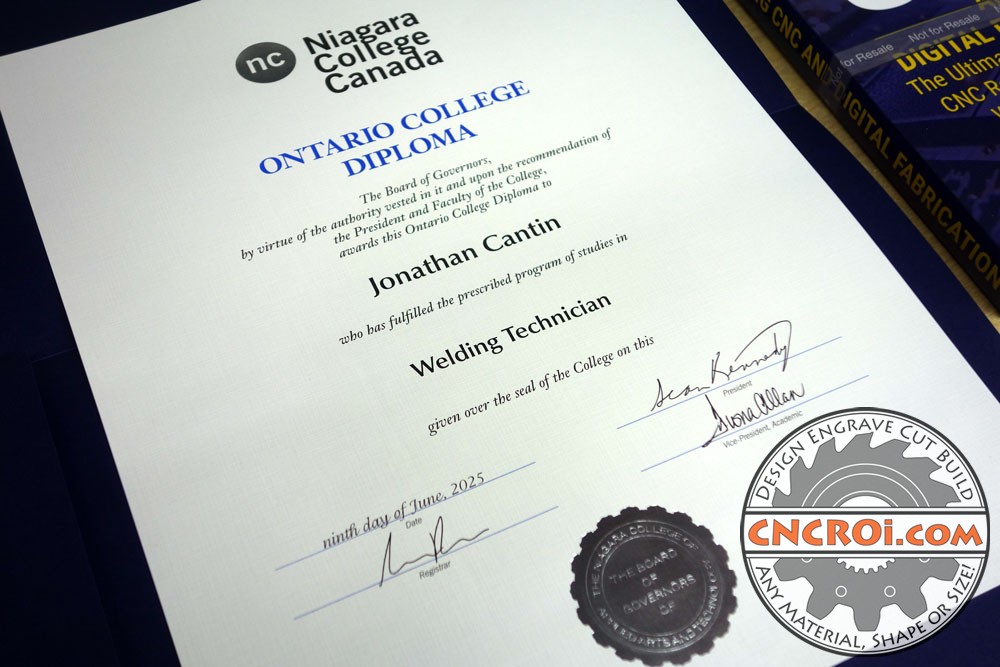
Welding school wasn’t a detour from my career — it was an investment back into it. It gave me a new layer of capability, one I knew I needed if I was going to take CNCROi.com into the next phase. Now, when I design a part or prototype a product, I’m not just thinking about toolpaths and kerf — I’m thinking about weld distortion, fixture setup, grinding access, and structural integrity. I see the whole picture now, not just the pixel-perfect render.
And yeah — I’m tired. But I’m also sharper, more dangerous (in the good way), and finally armed with the skills I used to outsource. I didn’t just survive welding school — I came out ready to fuse everything I’ve learned into a stronger, more capable shop than ever before.
Where I learned how to weld
This is one of the labs I spent two years in — a space that became oddly familiar, even comforting, despite the daily hum of grinders, the occasional explosion of slag, and the unmistakable scent of burning steel in the air. The tooling shifted here and there, but the heart of it stayed the same. I was lucky to learn from some seriously skilled welders, including Brendan whom you see in the above video — and a whole lineup of legends behind the hood.
Mike, Dave, Mark, Bill, Brad, Randy, and Amir weren’t just instructors — they were welders, first and foremost. Decades of real-world experience poured out of them, and they didn’t just teach me how to run a better bead — they taught me how to slow down, think critically, troubleshoot problems, and take pride in the process, not just the product. I came in expecting to learn a trade. What I got was a masterclass in humility, craftsmanship, and how to carry yourself in a shop — lessons that made me a better welder, sure, but more importantly, a better person.
I still wouldn’t dare call myself a “real welder” — that title’s earned over decades, not diplomas. But I’m one step up from a MIG monkey, and that’s real progress. I can weld in all positions, interpret drawings with confidence, and troubleshoot my own mistakes (and yeah, there are still plenty). Most importantly, I now understand how deep this trade goes — and why it deserves respect, not just admiration.
You are absolutely trading your health for money in welding, no way around that but as a teacher told me during class, get in, make your money, and get out as soon as you can before it catches up to you.
A Two-Year Crash Course in Sparks, Steel & Sweat
If you’re wondering how a guy running a CNC shop with machines worth more than a house ended up back in school — welding, of all things — welcome to the weird backstory behind this book.
I signed up for Niagara College’s two-year Welding Technician program not to change careers, but to round one out. I’d already gone from a ShopBot in a garage to running industrial lasers, CNC routers, plasma cutters, and more — and somewhere in the chaos of parenthood and entrepreneurship, I realized there was a hole in my skillset the size of a weld bead. I didn’t just want to outsource metalwork anymore — I wanted to understand it, do it, and yes, maybe even enjoy it.
So, I went back to school. At 48. Surrounded by kids young enough to call me “sir” though, being the same age as my teachers, I was generally called “old man.”
The program itself was intense — full of real-world welding: SMAW, GMAW, GTAW, and enough metal fumes to make your sinuses cry. It wasn’t glamorous but it was very enjoyable once you got the hang of it. You’re in a full-size welding and fabrication lab, torch in hand, hood down, blueprints beside you — translating raw steel into something functional. You learn to read drawings, do lift calculations, cut and weld in all positions, and test your own welds with destructive and non-destructive methods (read: break stuff on purpose).
It taught me things I didn’t expect — like how far I’d come, how little ego matters when you’re re-learning the basics, and how even now, in a world of AI and automation, hands-on skills are irreplaceable.
The textbooks? Rather dry and boring with barely a whisper about CNC or digital fabrication, even when it was obviously relevant. That’s what really sparked this book. I realized there was a massive gap between the analog and the digital, the torch and the toolpath — and I was sitting right in the middle of it.
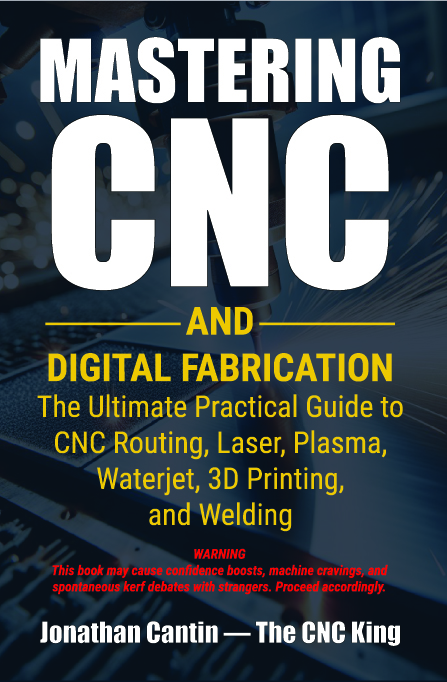
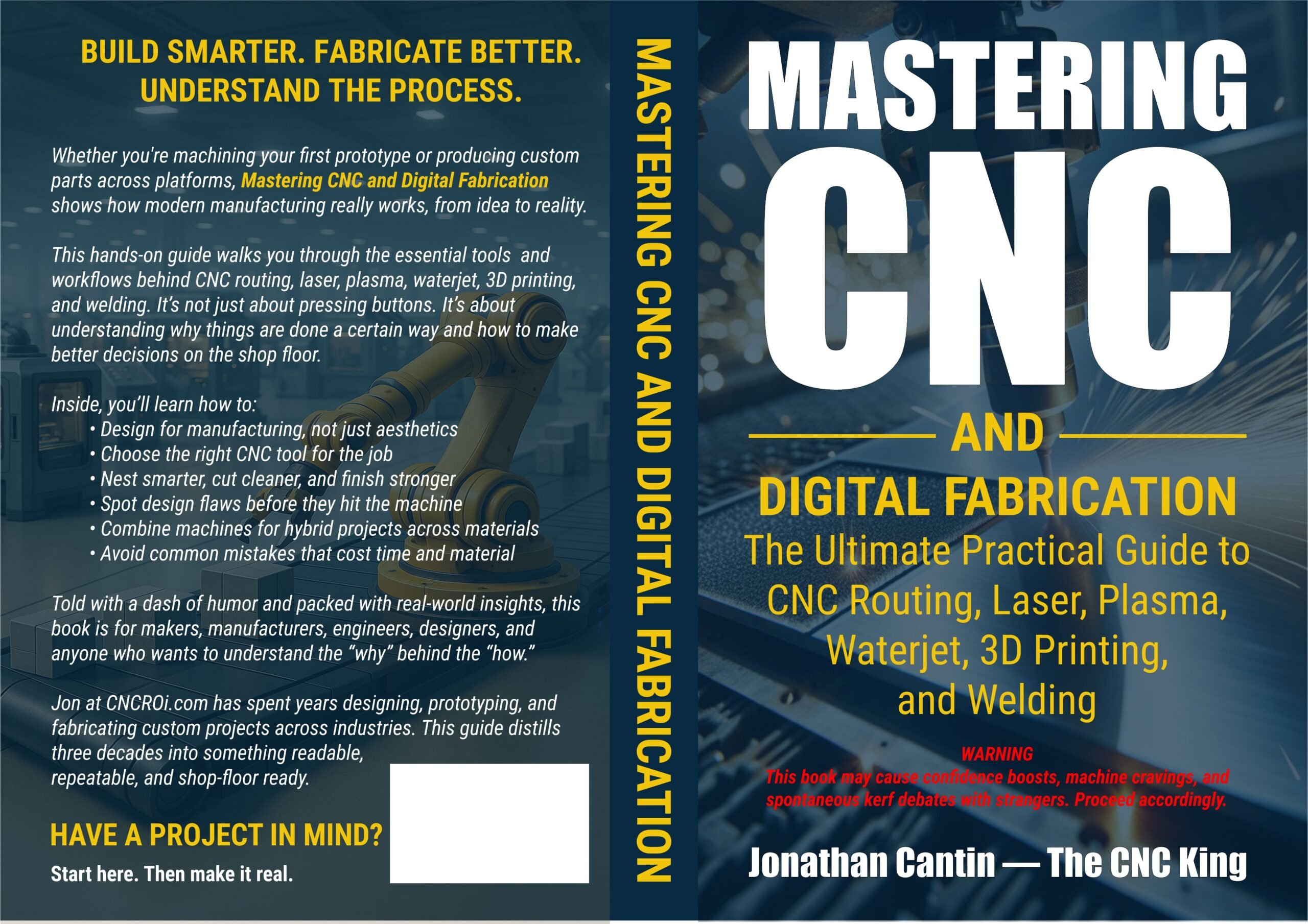
To be honest, without going back to school to learn properly the background and skillset required for welding, my book simply would have never come into being. Yes, it’s a mouthfull, but once you realize how related all these individual platforms are, you realize the synergy that they have by working with them all together.
This isn’t a glowing ad for Niagara College — though the instructors deserve a ton of credit. It’s more a confession: welding school reminded me why I started this whole journey in the first place. Not to just push buttons, but to build the machines that build the things. To understand where every spark, every step, every pass fits into the bigger picture.
So yeah — this book is for Simon. And for you. And for anyone else trying to build something real in a world increasingly full of noise.
What welding school taught me
Let’s talk specifics — because welding school isn’t just a montage of sparks and sweat (though there’s plenty of that). Over the two years at Niagara College, I dove deep into the fine print of what makes a weld good, strong, and most importantly, legal. We weren’t just fusing metal — we were aligning with codes, running tests, and learning what a weld failure actually looks like under magnification. Spoiler: it’s not always obvious.
I learned how to run open-root welds on pipe and plate, which is about as forgiving as a toddler with no nap. You screw up even slightly, and it shows — bad penetration, undercut, porosity — all the lovely terms that mean you start over. I spent hours grinding bad welds just to get another crack at doing them right. SMAW (stick), GMAW (MIG), GTAW (TIG), flux-core — all of them had their quirks, their ideal positions, consumables, and tolerances. The process everybody seemed to love and I hated though was GTAW, just a frustratingly slow and finiki process I’m happy I don’t have to touch ever again, though yes, I was doing it flat, horizontal, vertical, and overhead — GTAW is like trying to draw calligraphy with a flashlight while juggling filler rod.
One of the biggest learning curves wasn’t even the welding itself, but the prep. You don’t just grab a torch and go. You study engineering drawings, calculate weights and center of gravity for lifts, prep joints properly, and constantly think about heat input and distortion. I now understand why large structural weldments warp like bananas if you rush them. The physics behind welding is brutally real — expansion, contraction, and the art of anticipating both.
We also covered destructive and non-destructive testing methods, which was surprisingly fascinating. Cutting through a weld you spent hours perfecting just to see what went wrong inside? Weirdly satisfying. From dye penetrant to ultrasonic testing, the science of inspection gave me a whole new appreciation for quality control — something I now see reflected in every product I design or fabricate.
What I didn’t expect was how much of it would echo what I already knew from CNC work. Fixturing, tolerances, materials, heat control — it’s all part of the same language, just translated differently. Welding taught me patience, finesse, and how to build trust in your hands again — something no post-processor or simulation software can replicate.
What’s next?
Honestly, if Niagara College offered a third year in welding, I’d probably have signed up on the spot. There’s something addictive about getting better at something that used to intimidate you — laying down cleaner beads, understanding metal behavior, finally figuring out why your fillet welds kept shrinking your part by half a millimeter. I was just starting to hit my stride by year two and now, it’s over!
But at a certain point, I realized the bubble I was in was about to pop and reality was to return. It’s easy to feel productive when your days are filled with scheduled labs and assignments, but the real test isn’t in the classroom — it’s in the shop, with paying clients and tight deadlines. I wasn’t a kid fresh out of high school; I already had decades of design, CNC fabrication, and business experience under my belt. Welding school gave me the confidence to fuse it all together (pun intended), but it was time to take that next step.
So, a few months before graduation, I made a move that felt like the true turning point — I bought my first proper fixture table. It was symbolic in a way — a physical commitment to integrating welding into the workflow at CNCROi.com. No more clamping stuff to whatever flat surface was nearby. This was the beginning of deeper fabrication, more control, and more complex builds — all driven by the skills I’d earned the hard way: under the hood, with the sweat, burns, and occasional panic over tungsten contamination.
School was the foundation. Now the real building begins.