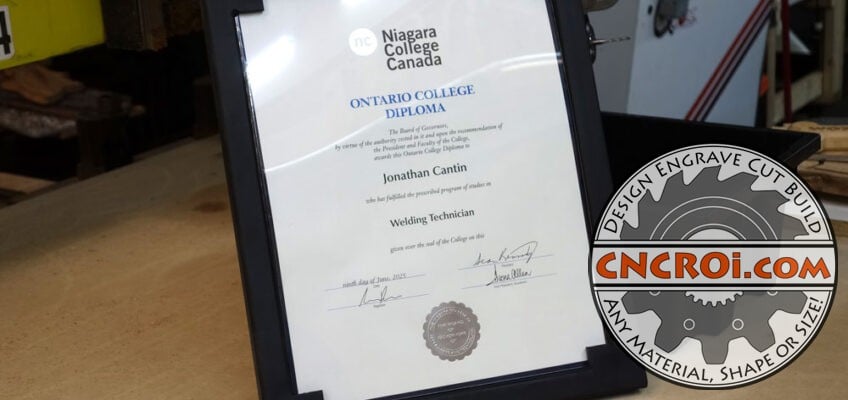
Custom Metal Picture Frame: Welding Diploma Display
CNCROi.com recently completed a project that looked deceptively simple yet turned into an exercise in precision, patience, and problem-solving. The goal was to design and build a custom metal picture frame that would hold a welding diploma earned after two years of hard study at Niagara College.
On the surface, a frame appears to be a straightforward object. However, once fabrication begins, it becomes clear that the path from raw steel to polished frame involves many more steps than people imagine. This frame needed to have weight, character, and permanence, because it was not just protecting paper, it was honoring years of dedication.

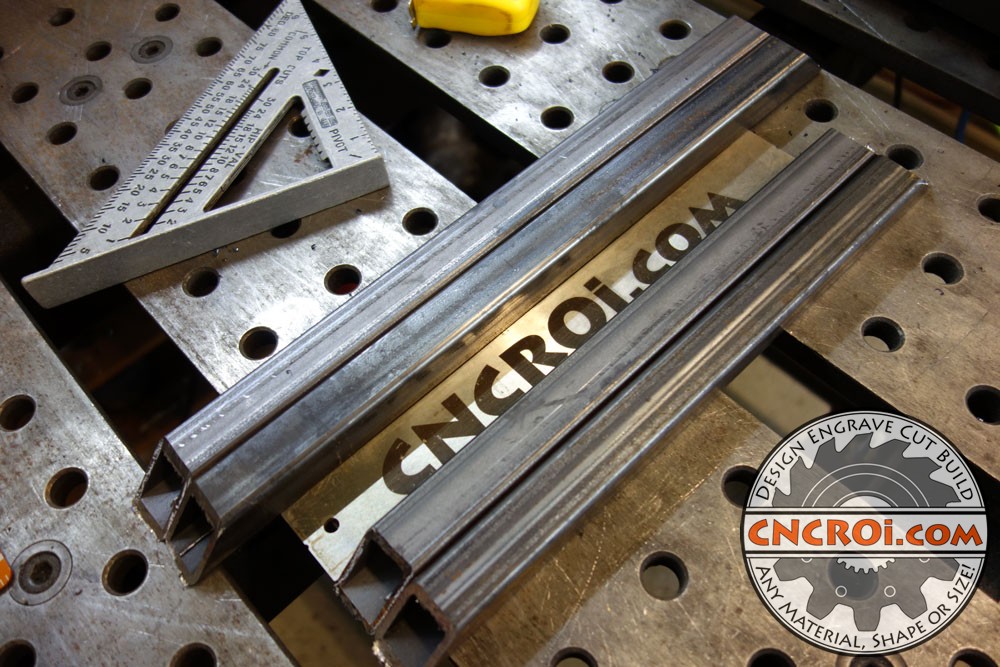
For the structure, CNCROi.com chose 1 inch (25.4 mm) square tubing with a 1/8 inch (3.2 mm) wall thickness. This specification was carefully selected for reasons of both function and feel. The thicker wall provided strength and durability, while also adding mass so the frame would not feel flimsy.
When someone lifts the finished piece, it weighs approximately 10 pounds (4.5 kg), giving it a satisfying heft. Much like holding a corporate award, the weight alone communicates value. If a diploma frame is too light, it feels underwhelming, but with this material, the frame immediately conveys substance.

Another critical advantage of using 1/8 inch wall tubing is its welding performance. Thinner walls can lead to burn-through when using flux core welding or rods, and nobody wants a diploma frame riddled with holes. Thicker tubing makes welding more forgiving and greatly reduces heat distortion.
CNCROi.com has long preferred this balance because it combines ease of fabrication with long-term structural stability. It is one thing to make a frame look good on day one, but another entirely to ensure it stays square and solid for decades.

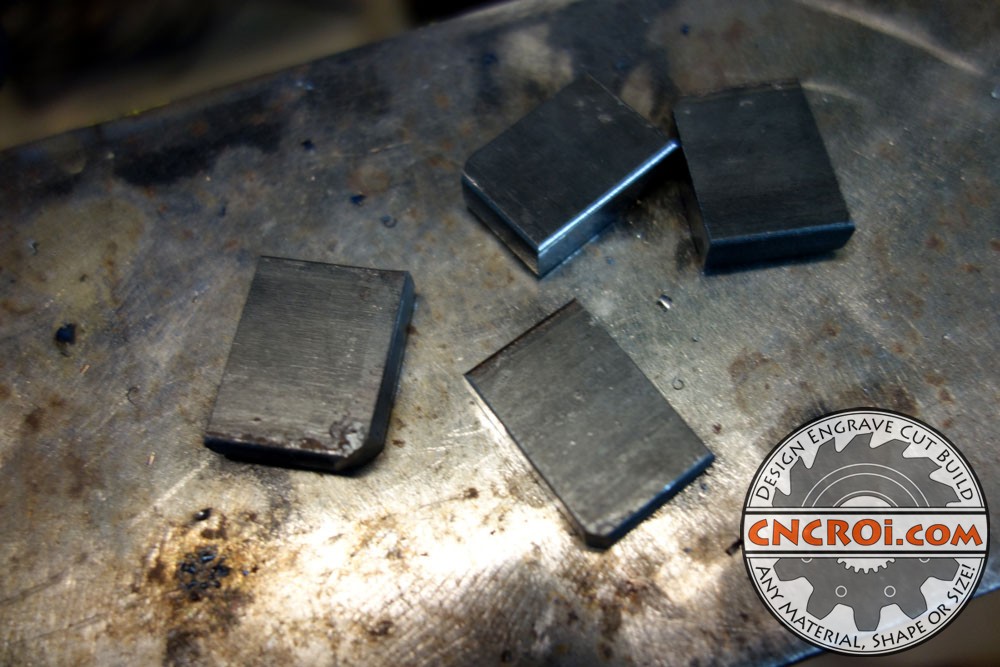
The fixture table in the shop was used partially to keep everything aligned, but small cut tabs became the unsung heroes of this project. These tabs acted as anchors, ensuring that pieces stayed put during assembly and welding. On the back, offset tabs were added so the frame would mount flush against a wall.
That clever design trick comes from CNCROi.com’s experience working with CNC-routed live edge tables, which are rarely flat. Just as shims keep tables parallel for machining, these tabs created consistent spacing for the frame. A detail like that may seem minor, but it guarantees a finished product that hangs properly and looks professional.
A recurring theme in fabrication projects is that appearances deceive. Looking at the finished custom metal picture frame, one might assume it could be built in an hour. In reality, each step builds on the previous one, and skipping any preparation leads to disaster.
Raw metal must first be cut, then cleaned, then squared, and only then can welding begin. Even with the right tools, setup for welding alone can take 10 to 15 minutes. Rushing any part of the process means ending up with a frame that is crooked or weak, which would defeat the purpose entirely.
Safety also plays a huge role in these projects. Welding requires a full checklist before striking an arc. Jackets, gloves, helmets, and goggles all come into play, and machines must be inspected before powering on. Viewers of sped-up fabrication videos often do not realize how much time is invested in preparation and cooldown. After each weld, safety gear comes off, adjustments are made, and the environment is reset.
The glamorous sparks are just a small fraction of the actual work. The behind-the-scenes reality is slower, messier, and more deliberate.

Measuring for this project was surprisingly low-tech but very effective. Instead of relying on rulers and precise numbers, the diploma itself became the measuring tool. By placing the diploma directly against the tubing, CNCROi.com could mark cuts with chalk.
This eliminated unnecessary calculations and ensured a perfect fit. Sometimes the simplest solution is also the most accurate. When something must fit into a frame, using the actual object as the template saves time and reduces error, proving that fabrication can be clever as well as technical.

Part of the build required cutting angle iron, and for that, the shop’s manual plasma cutter was put to work. With limited amperage, the cutter required multiple passes to slice through the 1/8 inch material cleanly. While CNCROi.com also has a CNC plasma cutter capable of slicing 2 inch (50.8 mm) steel with ease, that machine is tied to its table and not suited for manual work.
The manual cutter may be weaker, but it was the right tool for this job. Even though the cuts looked rough initially, the angle grinder smoothed them out, so nothing was wasted. Fabrication often comes down to using what is best for the moment rather than what is most powerful.

When it came to welding, shielded metal arc welding was considered, but with so many small sections involved, flux core was the better choice. FCAW handles small repetitive welds efficiently and offers enough control to keep heat distortion minimal.
That flexibility allowed CNCROi.com to move quickly without sacrificing quality. Decisions like these reflect the practical side of fabrication, where theory is balanced with reality. At the end of the day, results matter more than textbook preferences.

Gloves became another point of attention during the build. When grinding or sanding near a belt, gloves were avoided because of the risk of them being pulled into the machine along with fingers. On the other hand, when cutting tubing and producing sparks and shrapnel, gloves were absolutely necessary.
Hot shards are not pleasant on bare skin, so the right protection was used whenever possible. Some tasks forced pauses to allow small pieces of metal to cool before handling, adding yet another step to the process.
For the transparent cover, CNCROi.com chose PETG plastic at 0.06 inch (1.5 mm) thickness. Glass was unavailable in the shop at the time, but PETG offered clear advantages anyway. It is lighter than glass, resists shattering, and still provides excellent clarity.
Behind the diploma, MDF board acted as a backing, pushing everything snugly into place. This created a sandwich of steel, PETG, diploma, and MDF that locked together securely. It was a practical combination of materials that ensured both protection and stability.

Finishing the frame required more than a quick coat of paint. The first attempt, matte black spray paint, looked flat and uninteresting. CNCROi.com decided to sandblast the entire surface instead. Sandblasting creates a textured, industrial finish that resists fingerprints and provides a tactile, professional appearance. The difference was night and day.
Instead of looking like a generic store-bought frame, the custom metal picture frame now had personality and depth. It is small design choices like this that elevate a project from ordinary to memorable.

Assembly brought everything together in the final stage. The diploma was carefully placed inside, PETG on top, MDF at the back, and the structure secured with screws. Thanks to precise preparation earlier in the build, everything fit smoothly without adjustment.
The frame was not just a functional enclosure but a reflection of the achievement it protected. Strong, balanced, and finished with care, it stood as both a product of skill and a celebration of accomplishment.

What makes custom metal picture frames fascinating is how they combine engineering with aesthetics. The goal is to display something delicate while surrounding it with strength. That balance of toughness and elegance is not easily achieved, but CNCROi.com thrives on blending those qualities.
Customers who request such frames are often surprised by the level of detail involved, but the payoff is clear when they see the finished product on their walls.
The final weight of 10 pounds (4.5 kg) might seem excessive for a frame, but that was intentional. The heft creates a sense of permanence. It is not something that can be knocked down easily or mistaken for a flimsy decoration.
Of course, nobody should mount it above their bed unless they enjoy the risk of being startled awake by falling diplomas. Properly hung on a wall, however, it becomes a bold centerpiece.
Each element of the frame, from the offset tabs to the sandblasted surface, demonstrated careful foresight. Store-bought frames rarely consider such engineering details, which is why they bend, warp, or hang unevenly.
CNCROi.com anticipates these issues and designs around them. It is that proactive thinking that keeps frames functional and visually appealing long after they leave the shop.

The decision to use PETG instead of glass reinforced the frame’s practicality. While glass might have provided a traditional touch, PETG offered superior resilience. If the frame is bumped or transported, there is no danger of shards scattering across the floor.
For an office or workshop setting, that kind of everyday durability matters more than tradition. Customers appreciate knowing that their achievements are safe even if life throws the occasional bump their way.

CNCROi.com approaches projects like this with a blend of creativity and pragmatism. Tools and materials are not chosen because they sound impressive but because they serve the end goal effectively. The company knows that the real value lies in the results, not the showmanship. Watching sparks fly is exciting, but ensuring the frame sits square on a wall for years is the true measure of success.

The simplicity of the final frame was one of its greatest strengths. It did not need ornate patterns or decorative flourishes. Its clean lines and sturdy construction spoke louder than embellishments ever could. Customers seeking a custom metal picture frame often want exactly that, something understated but strong, and CNCROi.com delivers precisely that balance.
The frame highlights the diploma without overshadowing it.

Metal’s versatility also shone through in this project. Square tubing provided structure, angle iron added strength, PETG supplied clarity, and MDF offered backing. Each material played a role, and together they formed a seamless whole.
Fabrication is often about combining the right elements in the right proportions, and this frame was a textbook example of synergy. It showed how practicality and creativity can merge to produce a lasting result.
The time invested in the frame mirrored the effort behind the diploma itself. Countless hours went into cutting, grinding, welding, and finishing, just as countless hours went into earning the certificate.
Both the student and the fabricator dedicated time, energy, and skill to reach a final outcome worthy of recognition. In that sense, the frame was not just a container but a partner in honoring achievement.

Customers often underestimate the level of effort behind a custom metal picture frame. They see clean welds and smooth corners and assume the process was quick. Fabrication is like making a movie, where hours of filming are condensed into minutes of highlights.
Behind every visible weld are dozens of hidden steps. CNCROi.com embraces that reality because it knows the difference between good and great lies in those hidden details.

The durability of this frame ensures it will last as long as the diploma itself, if not longer. It will not bend, sag, or deteriorate over time. Humidity will not warp it, and impacts will not break it. In ten or twenty years, the diploma will still be displayed as proudly as it was on day one. That kind of longevity is part of what makes custom fabrication worth the investment.
Customers are not just buying a frame, they are buying peace of mind.

The shop resources used in this project highlighted CNCROi.com’s adaptability. Having multiple plasma cutters, grinders, sanders, and welding systems means the company can match tools to tasks.
Not every job requires the most powerful machine. Sometimes the smaller, more precise option is better. That flexibility allows the company to deliver efficiency without cutting corners, a balance that benefits customers directly.

By the end, the custom metal picture frame had become more than just a piece of steel. It was a story told in metal, plastic, and wood. It symbolized achievement, creativity, and durability, all wrapped into a square package. For customers, that story matters as much as the frame itself. Off-the-shelf solutions cannot provide that kind of personal narrative, but CNCROi.com can.

Even the simplest request is taken seriously because every project has meaning to the customer. A diploma earned over two years at Niagara College deserved nothing less than a frame that matched its importance, where metal is used to protect paper.

In the end, anyone in need of a custom metal picture frame should look no further than CNCROi.com. Whether for diplomas, photographs, artwork, or something entirely unique, the company brings the same blend of creativity, precision, and durability to every project. What may look simple at first glance is in reality the result of countless thoughtful steps.

Contact CNCROi.com today to discuss your project and let them create something that carries weight, both literally and figuratively, for years to come.